



High-temperature ceramics

Executive Summary
NORIA supported a global leader in ceramic manufacturing in designing a clean and cost-effective transformation of firing and drying processes at an energy-intensive industrial site.
The process operates 24/7, 50 weeks per year, combining high-temperature kilns and dryers operating around 150 °C, with partial waste heat recovery already in place.
Using system-level optimization, NORIA redesigned waste heat valorization and assessed electrification and storage solutions under real process, grid and economic constraints.
The selected pathway significantly reduces natural gas consumption while maintaining full production continuity. The solution combines technical feasibility, economic robustness and flexible financing models adapted to the client’s investment strategy.
Key Results
–3,500 tCO₂
per year
–17.3 GWh/year
natural gas consumption
+10.8 GWh/year
electricity consumption
Waste heat valorization
increased from 18 to 24 GWh/year
24/7 operational
feasibility preserved
Two financing
models assessed
Context & Challenge
The study was conducted for a large European ceramic manufacturing site, part of a global industry leader, operating 24/7, 50 weeks per year.
The process combines:
- High-temperature kilns for firing
- Industrial dryers (~150 °C) with strict humidity and quality constraints
The reference configuration relied mainly on natural gas (~70 GWh/year), with partial waste heat recovery already used to preheat dryers.
The challenge was to deeply reduce fossil fuel use and CO₂ emissions while:
- Preserving continuous production and product quality
- Respecting high-temperature kiln constraints
- Managing humidity sensitivity in drying processes
- Remaining economically attractive under grid and market constraints
This required a system-level redesign, not a single-technology substitution.
NORIA System Approach
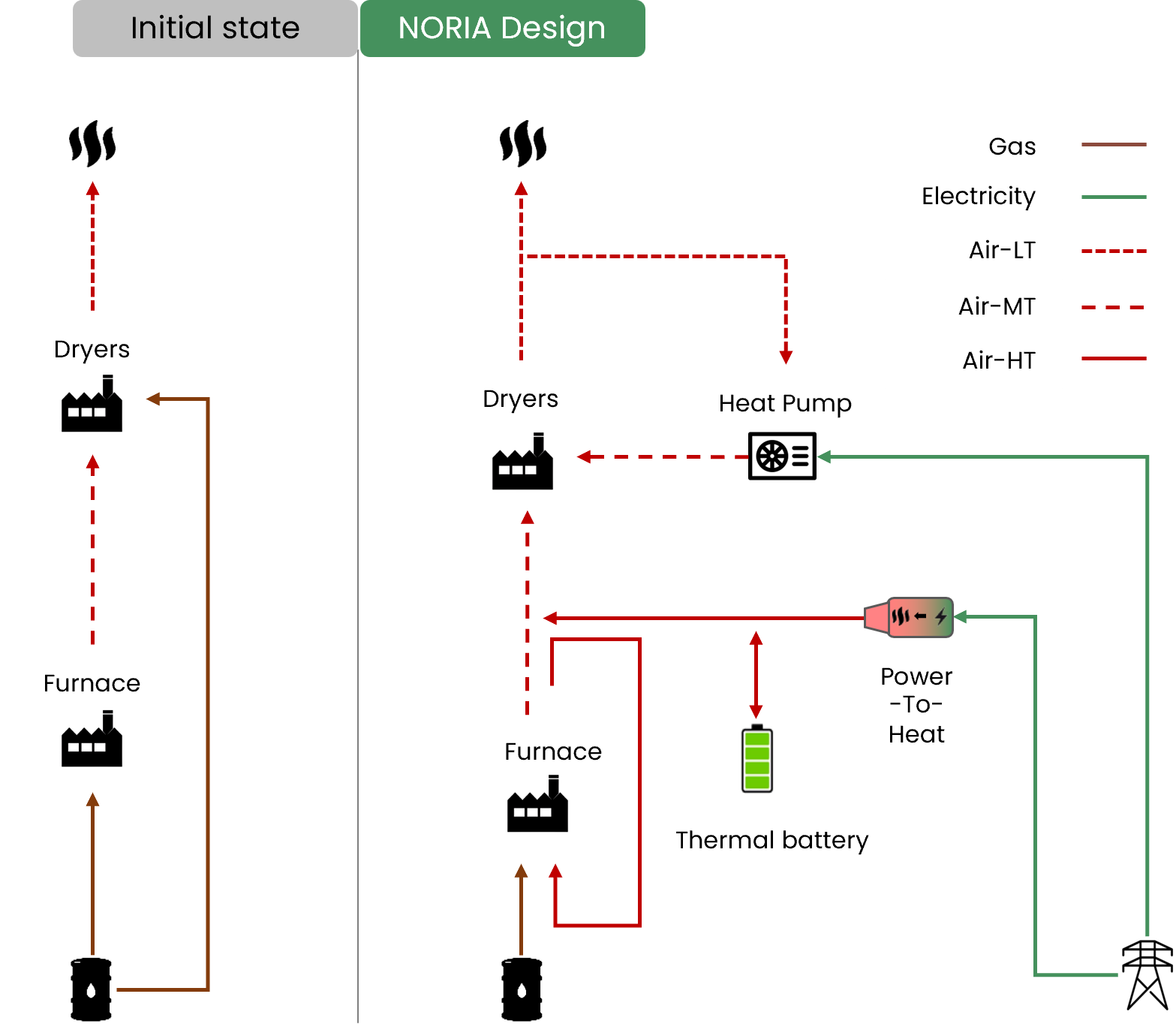
NORIA applied a holistic, system-level optimization framework covering heat sources, demands, infrastructure, and economics.
The approach combined:
Redesign of waste heat valorization
- reassessment of heat flows by temperature level, distance, and production rhythm
- optimized cascading across kilns and dryers
- increase of recovered waste heat from 18 to 24 GWh/year
Electrification, storage, and grid assessment
- evaluation and sizing of high-temperature heat pumps, power-to-heat, and thermal storage
- explicit integration of process constraints, electricity prices, and grid connection limits
- assessment of grid upgrade options (LV → MV), tariffs, and electricity taxes
Solutions were designed as a phased system, enabling progressive deployment and investment flexibility while maintaining coordinated operation across kilns and dryers.
Results & Decision Value
The selected pathway delivers measurable, robust benefits while preserving full operational feasibility:
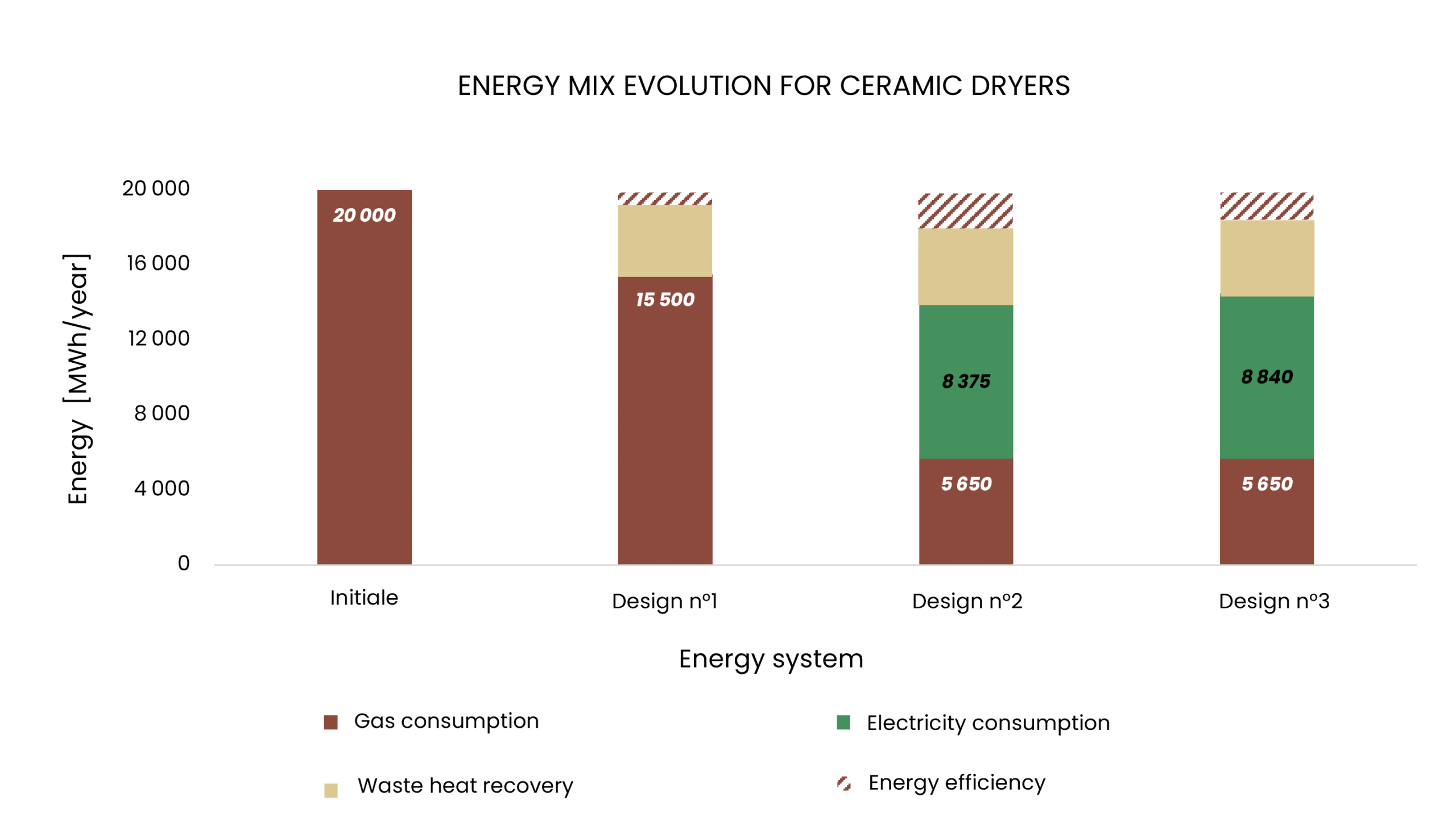
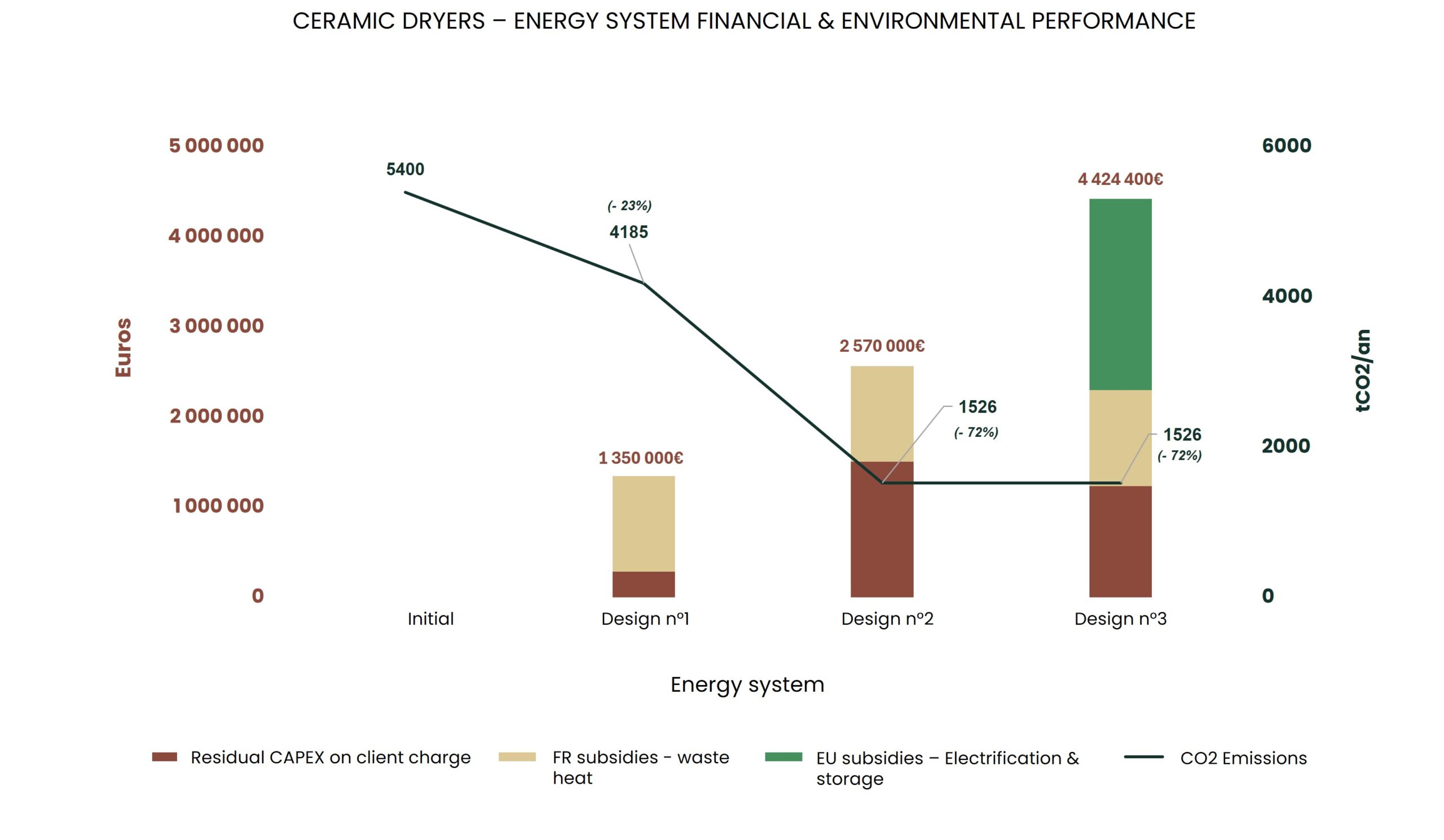
- –3,500 tCO₂/year (≈ 25% reduction vs. reference)
- –17.3 GWh/year natural gas consumption
- +10.8 GWh/year electricity consumption, enabling efficient gas-to-electric substitution
- Waste heat valorization increased to 24 GWh/year
- 24/7 operational feasibility preserved across firing and drying processes
Robustness was validated through:
- real and projected energy prices
- electrical grid constraints and upgrade scenarios
- process and equipment limitations
- regulatory levers and public funding mechanisms
Beyond technical performance, the study delivered clear decision insights:
- waste heat remains the priority energy source when optimally cascaded
- electrification can displace large amounts of gas with limited electricity demand
- grid upgrades can unlock long-term value, not just enable electrification
- staged implementation reduces risk and improves investment flexibility
- system optimization avoids over-investment in individual technologies
Two financing models were assessed on a consistent basis:
- direct CAPEX investment, optimizing total cost of ownership
- heat-as-a-service, aligned with a target IRR and client strategy
These results directly support secure investment and decarbonization decisions.
Want to explore a similar case for your drying system?
CASE STUDY
Pulp & Paper: Cost-optimal steam decarbonization
NORIA supported a leading European pulp & paper industrial group in designing a cost-optimal decarbonization pathway for steam production.
The studied site consumes over 300 GWh of energy per year, with steam as a critical utility.
Using hourly optimization models, hybrid solutions combining gas, electric heating and thermal storage were assessed under real technical, market and regulatory constraints.